

Image Stitching
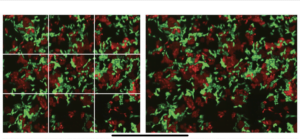
Image stitching is the process of combining multiple photographic images to produce a mosaic of high resolution image of an entire well or slide. Each image can be viewed individually or as a composite. It is ideal for analyzing tissue sections and stem cell colonies or for viewing every cell of an entire well plate. Images are produced in three fluorescence (GFP, RFP, DAPI) and bright field. Fluorescence scans can be merged to produce a high resolution multi-color image to highlight areas of interest. “Image stitching (Mosaicing) is considered as an active research area in computer vision and computer graphics.
Image stitching is concerned with combining two or more images of the same scene into one high resolution image which is called panoramic image. Its techniques can be categorized into two general approaches: direct and feature based techniques. Direct techniques compare all the pixel intensities of the images with each other, whereas feature based techniques aim to determine a relationship between the images through distinct features extracted from the processed images.
The last approach has the advantage of being more robust against scene movement, faster, and has the ability to automatically discover the overlapping relationships among an unordered set of images. The purpose of this paper is to present a survey about the feature based image stitching. The main components will be described. A framework of a complete system based on feature based approaches will be introduced. Finally, the current challenges of image stitching will be discussed” (NIST).