

30%
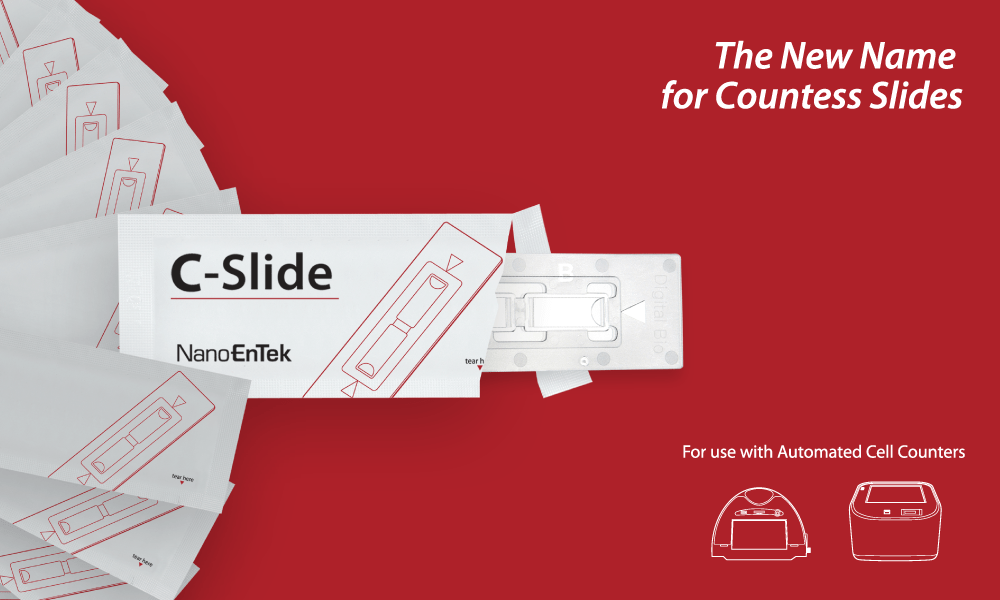
C-Slide for use with Automated Cell Counters
Fast
No requirement for coverslips or washing.


Cell Counting with the Countess & C-Chip
Cell counting is an integral part of determining cell concentrations for plating in culture, determining cell viability, and assessing the results of cell isolation procedures. It is recommended to perform an initial cell count prior to cell isolation; this number can then be compared to the cell count after cell isolation to calculate cell recovery. Additionally, viable cell counts should be performed when a decrease in cell viability may be expected, for example, when working with cryopreserved cells or cells manipulated ex vivo.
Cell counting can be performed using Trypan Blue or 3% Acetic Acid with Methylene Blue. When performing a total nucleated cell count, 3% Acetic Acid with Methylene Blue is recommended. Acetic acid lyses the cellular membranes, and the methylene blue stains the exposed nuclei. Because mature red blood cells lack nuclei, they are excluded when counting. Alternatively, Trypan Blue is recommended for counting viable mammalian cells. Trypan Blue penetrates the cell membrane, thus it enters the cytoplasm of cells with compromised membranes (dead cells) to stain them blue. The live cells remain intact and can be distinguished from dead cells by their ability to exclude the blue dye. In this case one would count the intact viable cells.
This protocol describes how to perform total nucleated cell counts with 3% Acetic Acid with Methylene Blue, and how to perform viable cell counts by Trypan Blue dye exclusion. Additional cell counting resources and templates to help streamline your assays are also available.You can dilute your sample with trypan blue at any ratio, but a 1:1 ratio is most common. Whatever dilution you use, make sure to note it down as you’ll need this for your final calculation.

Reduce
Waste
No requirement for coverslips or washing
Simple
Compatibility
Limit contact with expected dangerous materials
Rapid
Preparation
Exact and Solid
sustainable
Growth
Quartz grade optical plastic


Counting Cell in a Hemocytometer
The full grid on a hemocytometer contains nine squares, each of which is 1 mm2. The central counting area of the hemocytometer contains 25 large squares and each large square has 16 smaller squares. When counting cells that overlap an exterior line or ruling, count only those cells on the top or right-hand line of the large square to avoid counting cells twice. Suspensions should be dilute enough so that the cells or other particles do not overlap each other on the grid, and should be uniformly distributed. To perform the count, determine the magnification needed to recognize the desired cell type and systematically count the cells in selected squares so that the total count is approximately 100 cells, a minimum number of cells needed for a statistically significant count. For large cells, you can simply count the cells inside the four large corner squares and the middle square. For a dense suspension of small cells, you may wish to count the cells in the four outer and middle squares of the central square or make a more dilute suspension. Remember if a cell overlaps a line, count it as “in” if it overlaps the top or right-hand line and “out” if it overlaps the bottom or left-hand line. The area of the middle and each corner square is 1 mm x 1 mm = 1 mm2. The depth of each square is 0.1 mm. Hence, the final volume of each square at that depth is 100 nl.
C-Chip Disposable Hemocytometer
C-Chip Disposable Hemocytometer – Neubauer Improved The C-Chip by NanoEnTek is a disposable hemocytometer (the world’s first true one), used for manually counting cells under a microscope. But why would you want to use it when reusable hemocytometers and automated cell counters are on the market? Dispensable Haemocytometer, accessible with Fuchs-Rosenthal and Neubauer Improved Grid. First, due to their reliability. Disposable hemocytometers are inherently more reliable than reusable ones since the latter carries the risk of contamination due to potentially not being cleaned completely between uses, as well as the risk that the coverslip isn’t properly fitted during use. See this article for more details: No requirement for coverslips or washing, Limit contact with expected dangerous materials, Exact and solid, Quartz grade optical plastic. Second, manual hemocytometers are still more versatile. While automated cell counters are significantly faster than manual ones, the technology hasn’t advanced to the point where we can do entirely away with manual hemocytometers for instance, if a patient has red blood cells that are abnormally shaped (e.g., if they have sickle-cell anemia), then the automated counters won’t count them properly. In this case, manual cell counting is the best option for reliable results. Thus, manual hemocytometers still have their place in the lab or clinic despite the perks of the alternatives. See options for C-Chip grid patterns here >


Automated Cell Counters
Automated cell counters are machines that automatically count cells. The sample is loaded into an automated cell counter and it is forced through a small tube while the automated cell counter uses optical or electrical impedance sensors to count how many cells go through the tube. Used in medical and research labs, automated cell counters can be used on blood or urine samples to determine the number and types of cells present or to check the viability of a cultured cell line for research purposes. Some automated cell counters are for blood analysis and others for urinalysis. Features vary between the different automated cell counters, including sample size requirement, quantity and cell types it can analyze, data management, and whether or not it can differentiate between live and dead cells.
Countess or C-Slide
C-Slide – cell counting chamber slides – compatible with Countess. You may be looking at the C-Slide and thinking: “But I have a Countess automated cell counter. Is this even useful to me?” No worries: the C-Slide is developed and manufactured by NanoEnTek, the same folks who produced the Countess™ slides and the automated cell counter that uses those slides. Ready to Use For Your Convenience. In fact, NanoEntek explicitly says that “C-Slide” is the new name for “Countess Slides”! Countess™ Cell Counting Chamber Slides are exclusively bundled for your benefit. Each slide has two discrete, encased chambers that can be utilized to include one example in the copy or to count two unique examples. Cell including happens in a focal area of the counting chamber. The volume counted is 0.4 µL, equivalent to including four 1-mm2 squares in a standard hemocytometer. After use, Countess™ slides can be discarded with your ordinary biohazard squander. Dissimilar to a hemocytometer, there is a compelling reason need to clean Countess™ slides previously or after use. In fact, NanoEntek explicitly says that “C-Slide” is the new name for “Countess Slides”! That image isn’t photoshopped. Check the official NanoEnTek product brochure for yourself here.
In fact, C-Slides are compatible with EVE™ and EVE™ Plus cell counters, also NanoEnTek products! All these slides are built the same, are prepared in the same way, work with the same automated cell counters, and are disposed of after use. The only difference is the label on the packaging.

Fast and Accurate Results!
Accurate and Consistent Lab Work Deserves Reliable and Precise Equipment.
For any kind of quiries, Please call
900 Jorie Blvd Oak Brook IL 60523 USA
info@chinchillalife.com